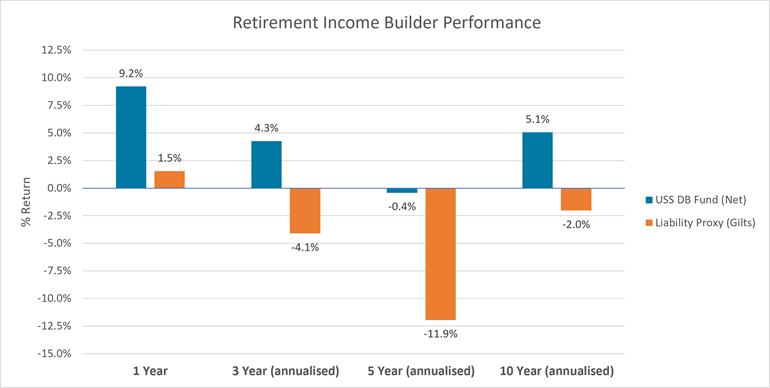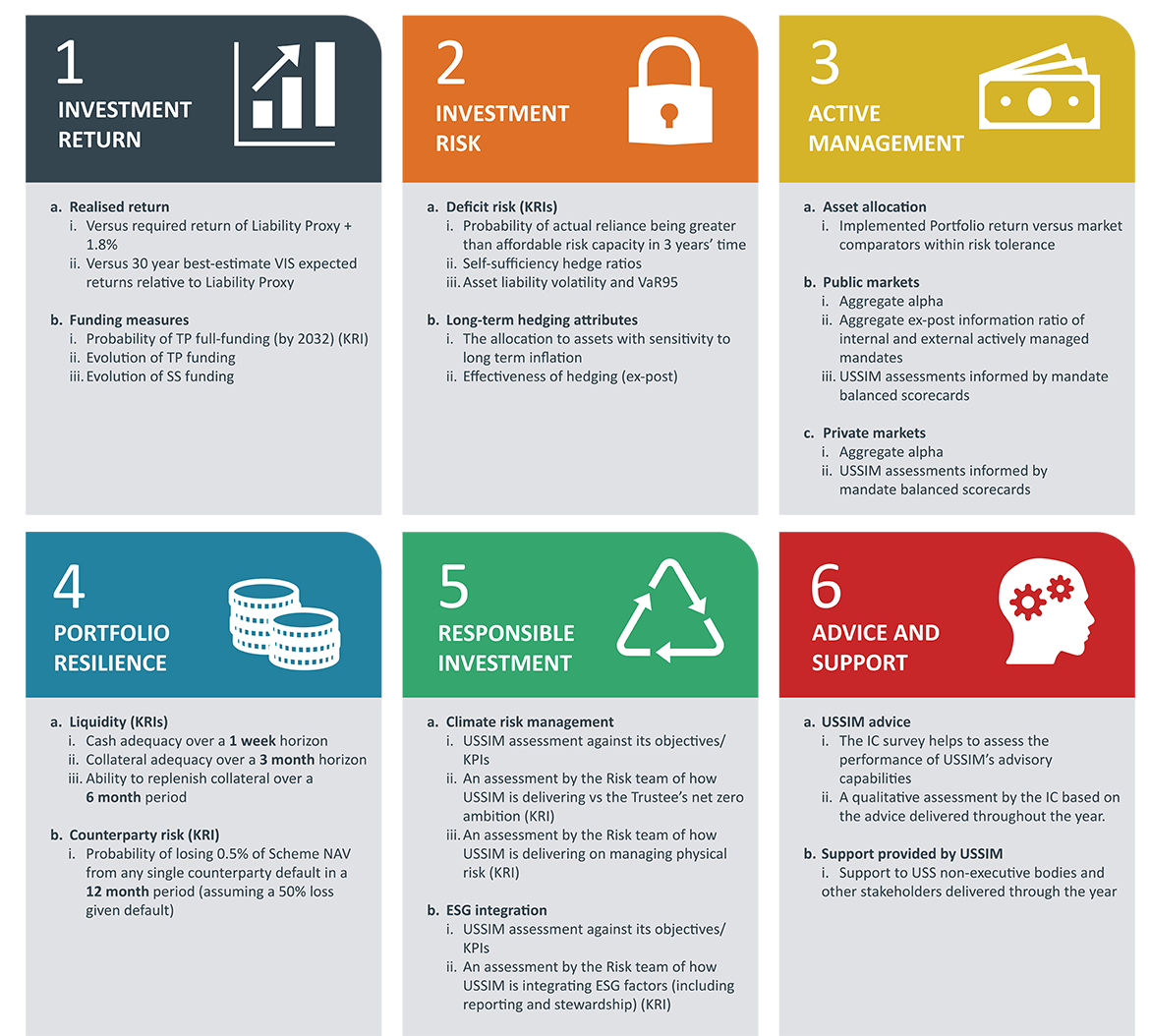
1. Investment return
a. Realised return:
i. Versus required return
ii. Versus expected return
b. Funding measures:
i. Probability of Technical Provisions full-funding
ii. Evolution of Technical Provisions funding level
iii. Evolution of Self-Sufficiency funding level
2. Investment risk
a. Deficit risk:
i. A projection of the Scheme’s affordability
ii. Self-sufficiency liability hedge ratios
iii. Asset liability volatility and Value-at-Risk (95%)
b. Other liability hedging attributes:
i. The allocation to assets with sensitivity to long-term inflation
ii. Effectiveness of hedging
3. Active management
a. Asset allocation:
i. Return versus market comparators
b. Public markets:
i. Return over benchmarks
ii. Information ratio
iii. USSIM self-assessments
c. Private markets:
i. Return over benchmarks
ii. USSIM self-assessments
4. Portfolio resilience
a. Liquidity (KRIs):
i. Probability of running out of cash
ii. Probability of running out of collateral
iii. Ability to replenish collateral
b. Counterparty risk (KRI):
i. Probability of losing 0.5% of Scheme NAV from a counterparty default
5. Responsible investment
a. Climate risk management:
i. USSIM self-assessment
ii. An assessment of how USSIM is delivering vs the Trustee’s net zero ambition
iii. An assessment of how USSIM is delivering on managing physical risk
b. ESG integration:
i. USSIM self-assessment
ii. An assessment of how USSIM is integrating ESG factors including reporting and stewardship
6. Advice and support
a. Investment Committee assessment of USSIM advice:
i. The annual Investment Committee advice survey
ii. A qualitative assessment by the Investment Committee
b. Support provided by USSIM:
i. Support to USS non-executive bodies and other stakeholders delivered through the year